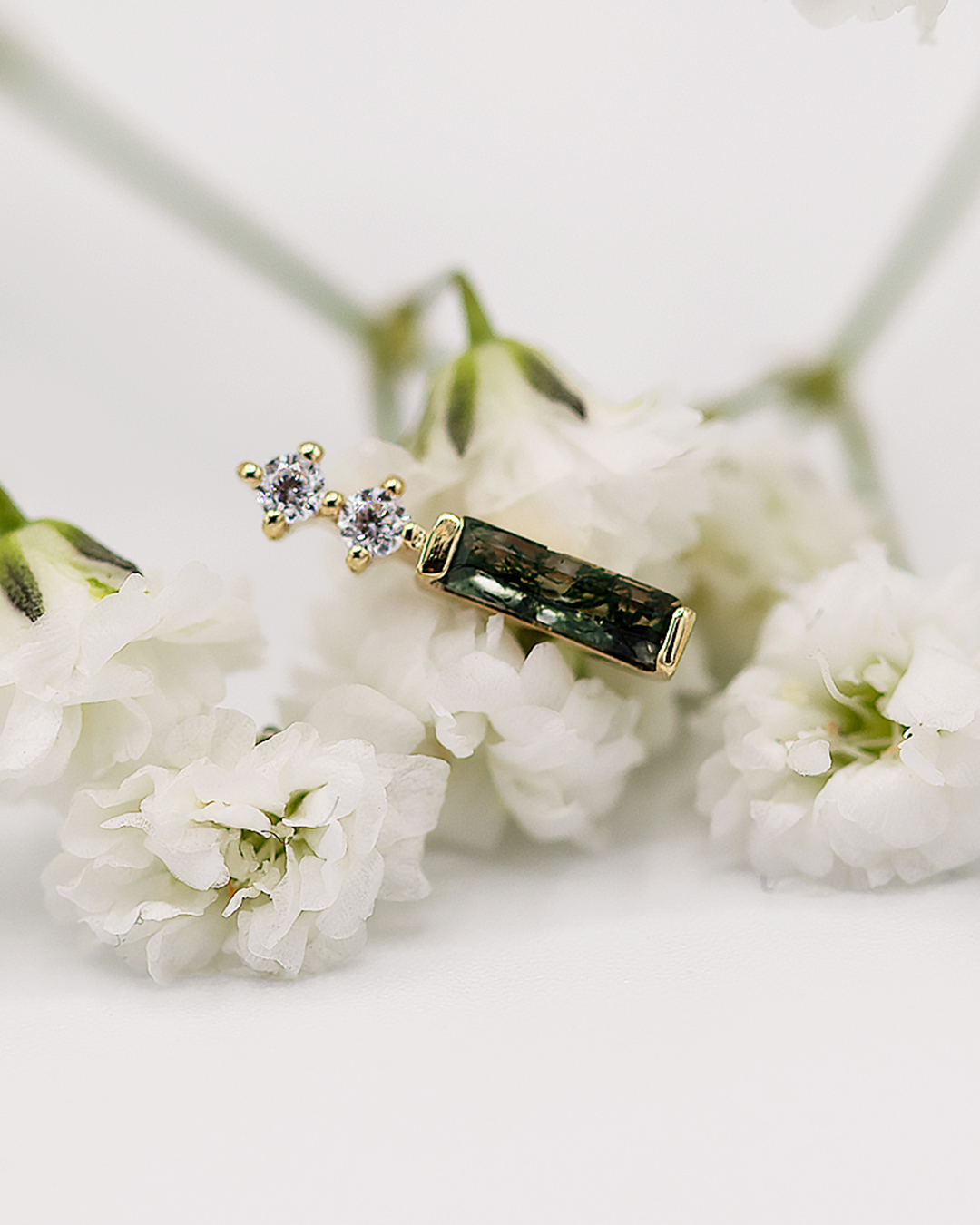
Exquisite craftsmanship in a compact format – where function, skin compatibility, perfect cut, and thoughtful design come together as one.
What distinguishes high-quality piercing jewelry from conventional jewelry? The answer lies in its multifaceted nature. Both types of jewelry can be crafted from fine materials, adorned with intricate details, and set with genuine gemstones. However, while traditional jewelry serves primarily decorative and aesthetic purposes, piercing jewelry must also be medically safe, suitable for continuous wear, and precisely tailored to the wearer’s anatomy. It is precisely these requirements that make it unique.
Piercing jewelry in a cultural context
Body ornamentation holds deep, ancient significance across a wide range of cultures. Whether serving as a spiritual symbol, a mark of status, or an expression of personal identity, piercings tell stories. In many African societies, they mark transitions into adulthood or signify specific social roles. In Asia—within Hinduism or Buddhism, for instance—nose piercings carry religious meaning. Among indigenous peoples, they represent a connection to ancestors and the natural world. In modern Western societies, piercings have become established as an expression of individuality, a sense of belonging, or a non-conformist lifestyle—particularly within queer, alternative, and creative communities.
Contemporary piercing jewelry is therefore more than just a fashion statement. It combines cultural heritage, medical standards, modern manufacturing techniques, and the highest design standards.
What characterizes classic jewelry?
Classic jewelry is typically crafted from precious metals such as gold or platinum and embellished with fine gemstones like diamonds, sapphires, or emeralds. These pieces are created primarily for visual impact, luxury, and emotional significance. They are often worn only on special occasions and do not need to withstand the rigors of everyday wear.
This is precisely where a fundamental difference from piercing jewelry becomes apparent: the latter is a daily companion and must be designed to withstand constant stress and direct skin contact.
Functionality as the top priority
With piercing jewelry, functionality comes first. It must be designed so that it causes no irritation—even during prolonged wear—and does not snag or injure the skin. It accompanies the wearer while sleeping, showering, exercising, and going about their daily life. Every angle and edge is carefully considered.
What is considered rustic or ornate in a bangle or ring would be simply impractical—or even harmful—in a piercing. Here, design only comes into play once safety and wearing comfort have been fully ensured.
Anatomical fit: Tailored to the body
Unlike conventional jewelry, which often follows standardized sizing, piercing jewelry must be precisely tailored to specific areas of the body. Whether helix, tragus, conch, or daith—each piercing requires specific lengths, diameters, and designs. Even the slightest anatomical differences affect placement, healing, and comfort.
For this reason, high-quality piercing jewelry is crafted by designers and manufacturers who either have personal experience with piercings or work closely with professionals. Anatomical knowledge is a prerequisite for successful execution.
Perfect polish – for health reasons
One of the most important quality factors for piercing jewelry is the surface. It must be absolutely smooth, non-porous, and mirror-polished. Why? Because even microscopic irregularities can lead to irritation, inflammation, or unwanted deposits.
While small burrs on brooches or bangles pose no problem, they are potentially harmful to health in the case of fresh piercings. That is why the elaborate high-gloss polish is not merely a decorative detail here, but a medical standard.
Why body jewelry is rarely stamped
Many people wonder why high-quality piercing jewelry—despite being made of real gold—does not bear a visible hallmark. The explanation is simple: a stamp would be located exactly on the part of the jewelry that is inserted into the skin.
This embossing creates small irregularities where bacteria or skin residue could accumulate—an avoidable source of germs. For hygiene reasons, many manufacturers therefore forgo visible stamping and instead include documentation regarding origin and materials.
Expertise behind every design
Piercing jewelry is often created in close collaboration with piercing studios, medical professionals, and experienced wearers. The questions designers ask themselves go far beyond aesthetics:
- Is the jewelry comfortable to wear even under headphones?
- Can it get tangled in hair or clothing?
- How can it be cleaned?
- Does he stay in the same spot when moving?
In comparison, many classic pieces of jewelry are created from a purely aesthetic perspective. They are beautiful, but not designed for prolonged skin contact or everyday use.
A piece of jewelry for every day
Piercing jewelry is not a special case—it is everyday jewelry. Many wearers remove it only rarely, if at all. Therefore, it must be comfortable, safe, and suitable for continuous wear around the clock.
High-quality piercing jewelry is functionally well-designed: flat profiles, secure settings, smooth transitions, precision-crafted threads, and perfect weight distribution. Minimalism and restraint are often expressions of technical sophistication.
Only the best for your body: an overview of materials
Only biocompatible, implant-grade materials are used in high-quality piercing jewelry:
- Titanium Grade 23 (ASTM F136): Hypoallergenic, ultra-light, durable
- Niobium: Soft, flexible, ideal for sensitive skin types.
- Gold (14k/18k): Nickel-free, durable, aesthetically sophisticated
- Platinum: High-quality, corrosion-resistant, luxurious
- Genuine gemstones: Securely set, without sharp edges or gaps.
All components must meet the medical requirements for implants, as they are worn directly in or on the body—often permanently.
Craftsmanship meets individuality.
A piece of piercing jewelry is more than just a fashion accessory. It is an expression of identity, a statement, and often a symbol of self-determination or belonging.
At MAYDUNA, you will find handcrafted jewelry pieces designed specifically for particular piercing locations. Combined with professional placement, anatomical advice, and a choice of style tailored to you, the result is a true work of art on your skin.
A work of art between medicine and fashion
High-quality piercing jewelry occupies the space between a medical implant, a design object suitable for everyday use, and a form of personal expression. It combines technical know-how, medical expertise, and the finest artistry.
Manufacturing requires more than just a talent for design: it demands a deep understanding of the body, healing processes, materials, and their effects.
Conclusion: An investment in health and style
Good piercing jewelry is more than just beautiful—it is safe and durable. Whether delicate, sparkling, or understated, it should always be impeccably crafted, anatomically sound, and made from high-quality materials.
Because your body deserves nothing less than the best.
If you are looking for exquisite piercing jewelry that meets the highest standards, we at MAYDUNA would be happy to advise you. We carry selected, certified collections and help you find the piece that suits your style and your body.